


Sermon on the First Sunday after Pentecost (June 7, 2026)
In the Name of the Father and the Son and the Holy Spirit, one God. Amen.
Who are saints? What makes a saint? And, why be a saint?
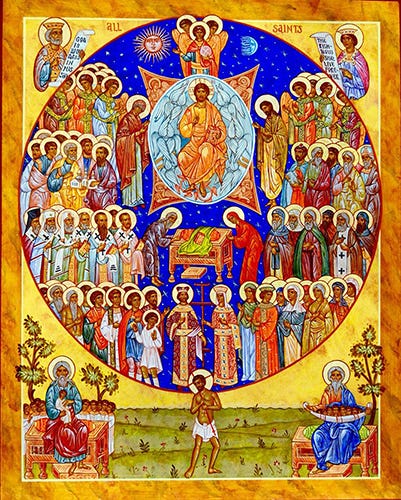
These are three simple questions that I’d like to talk about, since we are commemorating All Saints today. Saints surround us in church; they are present in our homes; they intercede for us; we choose them at baptism as our patrons for the rest of our lives; they are before God, and together with Him they desire that we also take up our places in the heavenly mansions.
But, who are saints? Are these people who lived perfect lives? Someone who did not sin? Or maybe God’s chosen ones who could do no wrong before Him?
The saints would be, in fact, the first ones to tell us that they are far from perfect, but greatest of sinners. They had this self-perception because they knew that we can do nothing to deserve God’s grace and mercy. And yet, that’s what He gives us.
The word saint or holy comes from a Greek word that means set apart or different. For example, a church building is called holy because it is unlike any other building. So, a saint or a holy person is set apart or different from other people.
How exactly are they different? In the way they dedicate themselves to following Christ’s words, not in the way He favors them. God does not show favoritism (Acts 10:34, Romans 2:11); as His creation, we are all equally precious in His sight (Psalm 139:14).
God is the One Who sanctifies us, but He does not do it blindly. There must be some reciprocity – we need to want to be holy. And we express our desire for holiness in the way we live our every-day life.
What makes a saint? What exactly do saints do that sets them apart? Reading the Lives of the Saints may help us come up with some common themes and ways a person works our his/her salvation, but each saint is also a unique individual, just like all of us here are unique. What works for some may be absolutely wrong for others. The saints show us that there are many paths that lead to a full and proper relationship with God.
No matter how different the path of each saint is, all saints in the end point to the Prototype of our holiness – the Lord Jesus Christ. If you recall on the first Sunday of Great Lent, we talked about icons and how each icon points beyond itself – to the saint depicted on it, and ultimately to Christ Himself. Christ is the Image or Icon of God, and we are created in Christ’s image. We are His icons. In a similar way the life of each saint points beyond the saint to the One Who gives us life – the Life-giver and Lover of all mankind.
So when we want to come up with some common features of what makes a saint, we need to look to the Source of all holiness. In today’s Gospel lesson Jesus lays out some conditions, if you will, for sainthood.
We must confess Him before others, if we want Him to confess us before His Father (Matthew 10:32). Confess here means to speak the same thing as He speaks or be in full agreement with Him. We can’t be His followers, His saints, if we disagree with what He says. Christ’s word is our word; His will is ours to follow; His life is ours to imitate.
We are to love Christ more than we love our father and mother, our son or daughter (Matthew 10:37). Jesus does not stand for split loyalties. He is above everything else in our life. If He is at the top, nothing and no one else can be there with Him.
And, we must take up our cross and follow Him (Matthew 10:38). The cross is a symbol of death. People who carried their crosses, went to a sure death. The cross also signifies this earthly life – it ends in death. For us to take up our cross and follow Christ is to follow in His footsteps. It is to dedicate our life to Him and do as He did.
What Jesus is asking here is not easy. Sometimes we tend to massage the meaning of His words because they make us uncomfortable. Imagine the person you have loved the most in your life, Jesus expects us to love Him more than we love that person. So we look for ways to soften His words. But He said what He said. He has set the expectations. And they are high.
So why be a saint? Why strive for something that is hard and requires actual sacrifices? I imagine that there are people who are content with cruising through life which seems to have no meaning and leads to a hole in a ground. It’s pointless, it’s short, and it ends.
But there must be something more than just this futile meandering, right? Otherwise, why are we even here?
Jesus is not only the One Who gives us life, He also gave us the most perfect example of how to live it (and continues to give examples through His saints); therefore, He fills our life with meaning.
When we confess Him before others, we set our mind on His words, leaving no space for nonsense that surrounds us to fill our minds. When we choose to love Him above all others, we do not reject others, but learn to love them with the love that Christ has for us. When we take up our cross and follow Him, we learn of selfless love.
And that’s the paradox of a truly Christian life – our life is full when we live it for others, not just ourselves. Jesus set this example by His life and by His Cross. The meaning of our life is outside ourselves – in others. We are to choose Christ, and confess Him, and love Him, and follow Him, so that He would teach us how to love others.
That’s what saints do. Saints are living icons of Christ; their life and their actions, as imperfect as they may be sometimes, point beyond them to the Prototype.
As imperfect as we may be, we are saints in progress. Imitate those saints that are already glorified by confessing Christ before others, by loving Him above all, and by taking up our cross and following Him to the fullness of life, glorifying and worshiping Father, Son, and Holy Spirit, always, now and ever and unto ages of ages.
Amen.
Find us on Spotify.


