


Sermon on the Second Sunday of Pascha (April 19, 2026)
In the Name of the Father and the Son and the Holy Spirit, one God. Amen.
Christ is risen!

He came from humble beginnings – poor but pious family. Two loves were instilled in him from early on – love of God and love of work. Being a good Jewish family, they read and learned the Scriptures. Along with the rest of Israel, they awaited their Messiah foretold by the prophets from of old.
Did he know what he was signing up for? Do we know what we are getting ourselves into when we decide to follow the Teacher? None of the apostles did, not until after the Resurrection, and some even after that cosmic event had some doubts (Matthew 28:17).
Not knowing the full extent of his decision to follow Christ, Thomas was nevertheless deeply committed to the Lord. When Jesus was explaining to His disciples what had happened to Lazarus, that he had not merely fallen asleep but died, and now the Lord wanted to wake Lazarus up, it was Thomas who said, “Let us also go, that we may die with Him” (John 11:16).
The disciples did not want Jesus to return to the place where he was almost stoned the last time He was there (John 11:8), but He was determined to raise His friend from the dead before His own Resurrection. And so Thomas decided that if He goes to die, then we will die with Him.
Did he know what he was saying? Did James and John understand the weight of their words when they told the Lord that they are able to drink the cup that He is to drink (Matthew 20:20-23)? How about Peter, who promised to die with the Lord before he would deny Him (Matthew 26:35)?
No, like many of us, they had no idea what they were saying at the time, but in time they fulfilled their words. Thomas did die with the Lord, but not on the Cross; rather, being speared in India.
The death of the Messiah devasted Thomas. He became aloof, spending more time on his own, away from the other disciples. So when the risen Lord first appeared to them, Thomas was not there. He was unwilling to believe them when they finally told him that they had seen the Lord.
Many people see things, especially when they are in shock and grieving. They are susceptible to believe the supernatural in such a state. Thomas did not want to just believe; he wanted to test, to make sure his eyes were not deceiving him.

“Unless,” he said, “unless my hands touch His flesh, I cannot believe” (John 20:25).
Unless I see the Master myself,
unless I see His side flowing with baptismal blood and water,
unless I see those wounds, which healed all mankind,
unless I see not a spirit, but flesh and bones… (from Vespers hymn at “Lord, I call”)
His doubt produced confident faith in Thomas. He was not a disillusioned apostle, that was Judas. Judas gave up even before the Lord died; Thomas had questions while the resurrected Lord appeared to his friends.
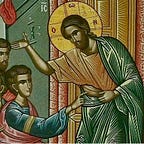
Thomas doubted, but the Lord did not reject him. He revealed Himself again, this time just for Thomas, to reassure him that his doubts were fruitful. And this appearance also reassures us who are full of doubts. If we haven’t struggled with what we believe, we haven’t really believed yet. Doubt is part of the process. Thomas shows us how it’s done.
As the Lord appeared just for him, He did not scold or reject Thomas, but simply said, “Come and see the wounds of the God Who does not desire the death of others to reconcile humanity with Himself and to re-establish proper relationship with His creation, but the wounds of the God Who is willing to die for you.”
Whatever our conception of God is, Pascha always upends it. God is dying to have a relationship with us. Who could conceive of such an idea? Certainly no ancient people could. Nobody could imagine any god dying for his creation. Because no god could do it. Only the One True God was capable of it.
And then He appeared to His doubting disciple, let him probe His wounds, and gave him a commandment, “Proclaim My Passion and My Resurrection to all, that everyone may join you in your cry, ‘My Lord and my God!’ (John 20:28) (also from Vespers hymn at “Lord, I call”)
Thomas was there on Pentecost, when the Holy Spirit descended upon the Church. He went on to preach, proclaiming Christ’s Passion and Resurrection in the present-day Iran and India, baptizing people, ordaining priests and bishops.
In India he left his biggest mark. The king there wanted to build a palace unlike any other palace ever built. (We could say that ambitions of politicians never change.) Thomas said to him that he could build such a palace. The king paid him upfront and left to travel his vast kingdom.
And Thomas began building in earnest. Every starving and poor person that was neglected by the king was clothed, fed, and sheltered. All along Thomas never stopped proclaiming what the Lord commanded him. Multitudes of pagans abandoned their idols and became Christians.
When the king returned, he was not overly amused – there was no money, but more importantly not even a foundation for his grand palace. As these things go, Thomas found himself imprisoned and awaiting dreadful tortures that the king was devising for him.
But that very night, king’s brother, who was very sick, had a vision of an angel who took him away to show him a magnificent palace built in the Kingdom of the righteous. The angel said to the king’s brother, “This is the palace Thomas has built for your brother.”
When the brother told the king of this vision, both of them repented and asked for baptism. Various people in power, for a very long time now, have been trying to build a palace unlike any other, but none of them can surpass the palace built by Saint Thomas for the king of India. And so Thomas became a master builder.
He went from there to preach the Gospel in another kingdom. But the king there did not take too kindly to Thomas converting his wife and children. He had five soldiers pierce Thomas with spears. So the apostle who was ready to go and die with Christ fulfilled what he had promised.
The Church today calls the doubt of Thomas most wonderful because it brought the hearts of the faithful to knowledge. Through his doubts and his questions and his requests to test the Lord’s resurrected flesh he provided proof to every doubter (basically all of us) that Jesus is indeed risen.
Like Thomas, we can never know what exactly we agree to when we decide to follow the God Who is willing to die for us. But also like with Thomas Jesus will not reject us when we have honest doubts. Because honest doubts produce faithfulness. And in faithfulness we are capable of confessing Christ as our Lord and our God, always, now and ever and unto ages of ages.
Amen.
Christ is risen!
Find us on Spotify.
Intro and outro melody:
Rule of Life
Music from #Uppbeat (free for Creators!):
https://uppbeat.io/t/brock-hewitt-stories-in-sound/rule-of-life
License code: MOHT7GAHFYHX7I1Y


